Objective
The objective of this study is to identify how passenger travel behavior changed before and during COVID-19 through comparative analysis.
Methodology
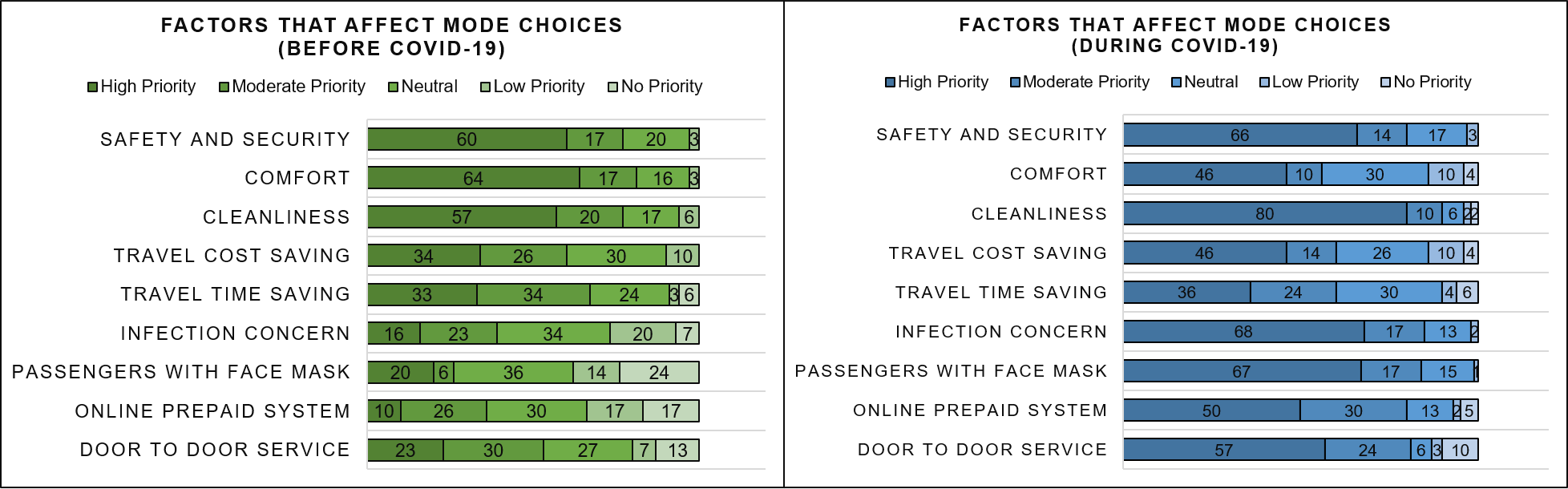
- Study Area: Rajshahi City Corporation (RCC) area, a medium-sized (96.72 square kilometer) divisional city representing a compact urban network with a total 552791 population.
- Survey Design: Online questionnaire (Collected in May 2021); 100 responses collected via snowball and random sampling methods.
- Collected Data: Demographics, trip purposes, travel distance, weekly trip frequency, mode choice, and influencing factors.
- Statistical Analyses: Mann-Whitney U, Spearman’s ρ, McNemar–Bowker, Wilcoxon Signed-Rank, and Multinomial Logistic Regression.
- Outcome: Established a before–and–during COVID-19 comparison of trip purpose, distance, frequency, and mode preference.
Key Findings (Travel Behaviour)
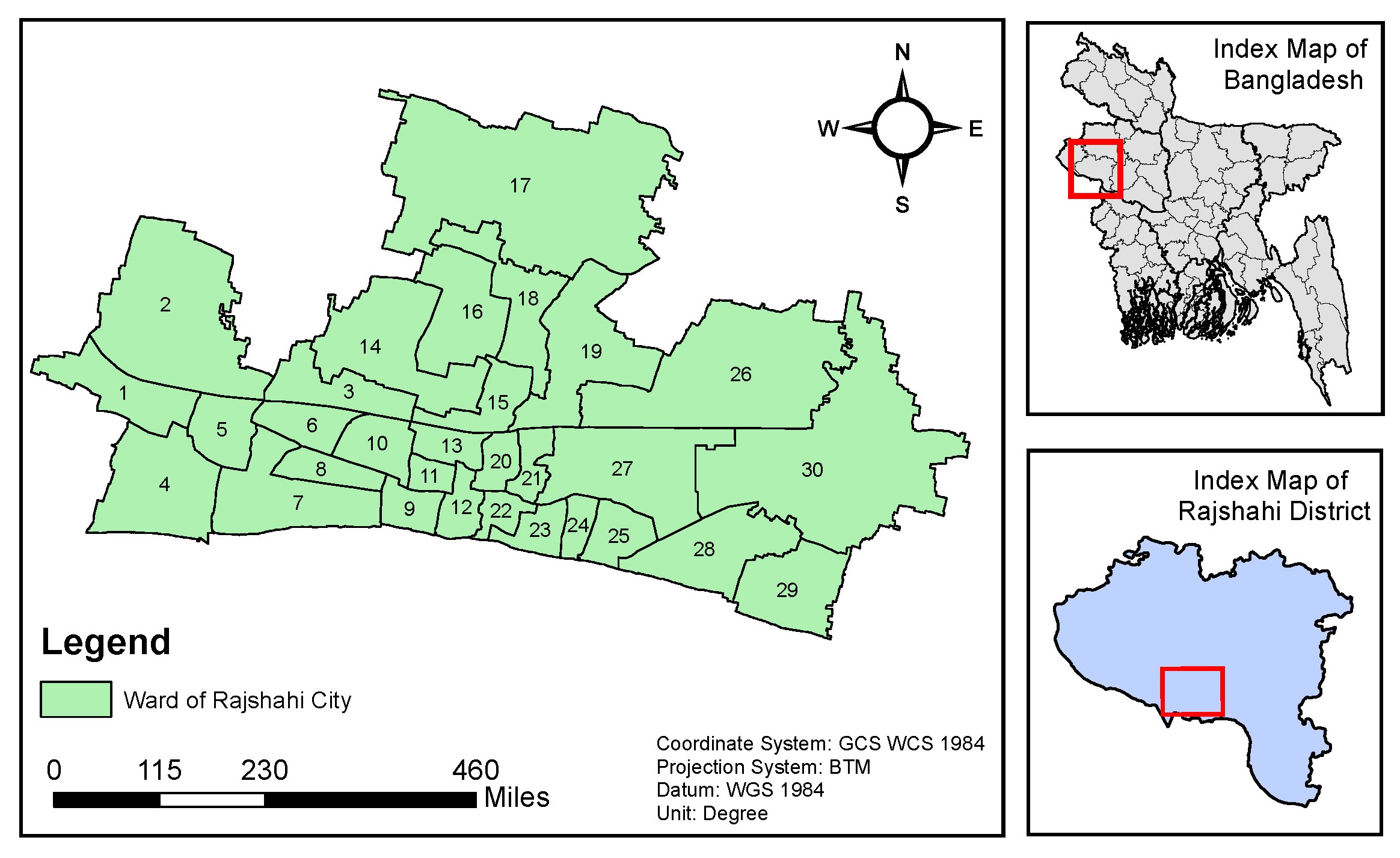
- Trip Purpose: Study was the major trip reason before COVID-19 (66.7%), but fell drastically to 16.7% as institutions closed; meanwhile, work trips doubled to 33.3%, becoming the dominant purpose.
- Travel Distance: Long trips (> 3 km) declined from 66.7% to 33.3%, while short trips (≤ 3 km) rose sharply, indicating restricted movement.
- Travel Frequency: Travel activity dropped markedly as, trips fewer than two per week rose from 6.7% to 53.3%, while frequent travel (> 7 trips/week) decreased from 33.3% to 3.3%.
- Mode Choice: Public transport share fell from 56.7% to 13.3%, while private modes increased to 53.3%, showing a clear shift toward personal mobility.
- Overall: People traveled less often, shorter distances, and by safer private modes.
Key Findings (Mode Shift)
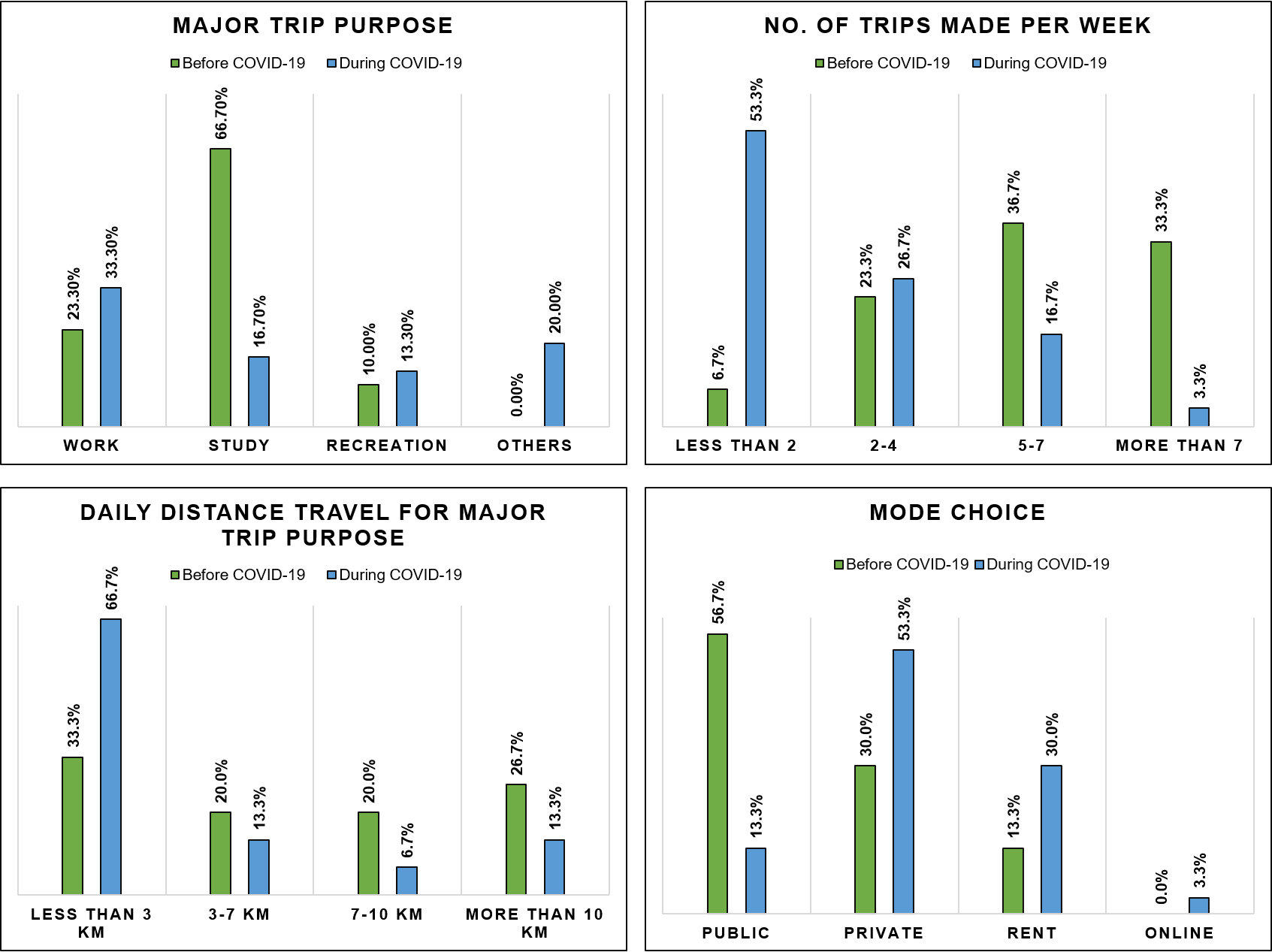
- Shift from public to private is evident but not statistically significant, as 20 respondents moved from public to private, while none shifted in the reverse direction; however, p = 0.031 (> 0.0125) indicates the change is not significant.
- Public to rent mode shows a similar trend, with 20 respondents shifting from public to rent, compared to almost no reverse movement, yet again not statistically significant (p = 0.031).
- Private mode gains from rent users, where 3 respondents shifted from rent to private, reinforcing a preference toward more controlled transport options, though p = 1.000 confirms no significant difference.
- Minimal adoption of online mode, with only 1 respondent shifting from public to online, indicating that virtual alternatives remained largely negligible in overall mode choice.
- Overall pattern indicates safety-driven behavioral change, where movements consistently flow away from public transport toward private and rent modes, even though none of the pairwise shifts are statistically significant after Bonferroni correction.
Key Findings (Influential Factors for Mode Choice)
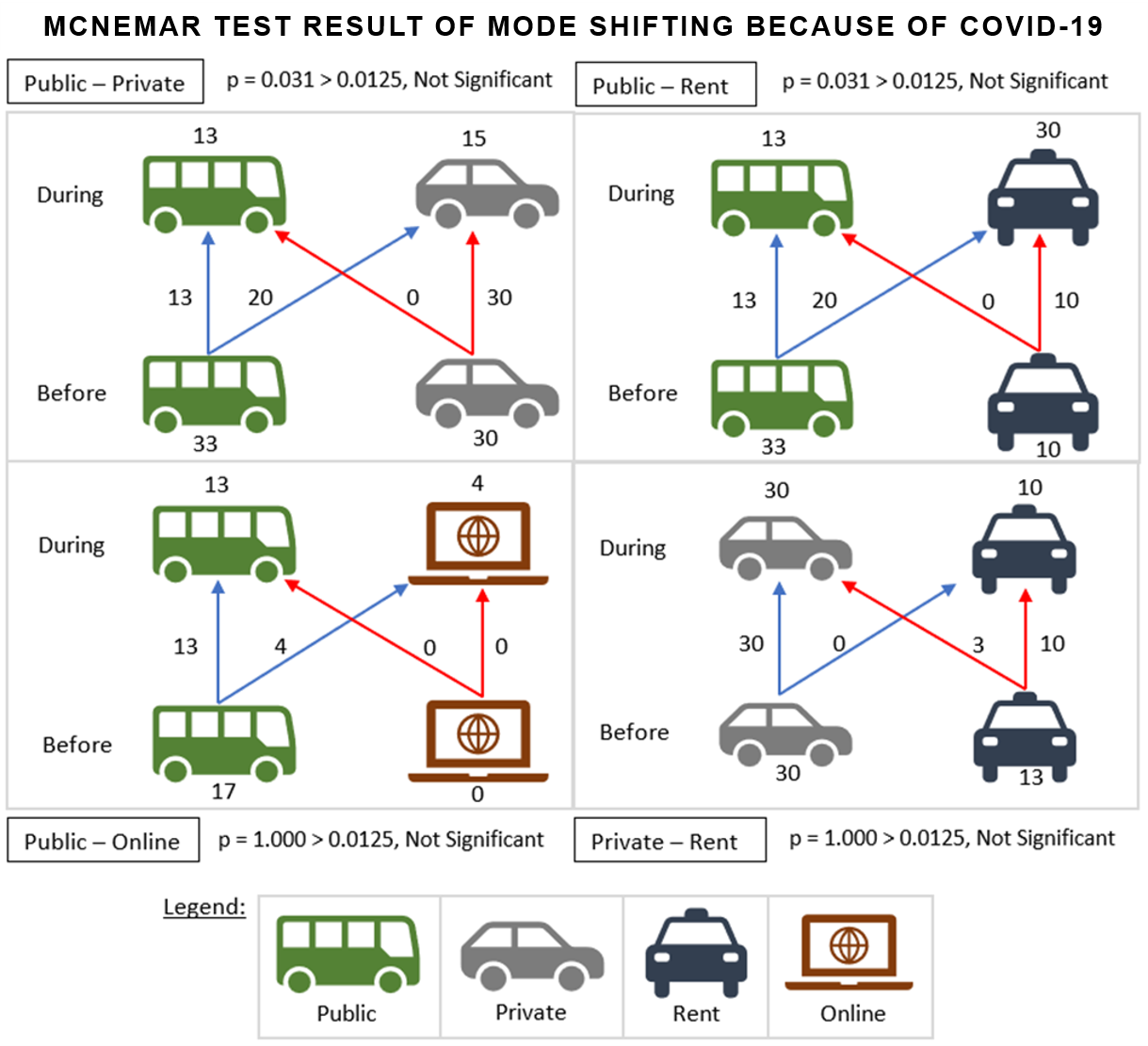
- Priority shifted from comfort to cleanliness: Before COVID-19, comfort ranked highest (64% high priority), but during COVID-19, cleanliness became dominant (80% high priority), reflecting hygiene-driven behavior change.
- Safety remained consistently important but slightly increased, with 60% (before) rising to 66% (during) as high priority, reinforcing risk awareness.
- Infection-related concerns surged sharply, where infection concern jumped from 16% to 68% high priority, and face mask importance from 20% to 67%, showing strong pandemic influence.
- Final Regional Diversity: Composite weighted overlay classified 4 districts as very good, 26 as moderate, 23 as bad, and 11 as very bad.
- Digital and contactless preferences increased significantly, as online prepaid systems rose from 10% to 50% high priority, and door-to-door service from 23% to 57%, indicating a shift toward minimizing exposure.
- Traditional factors like time and cost lost relative dominance, as newer health-related priorities overtook them despite moderate increases (e.g., cost: 34% → 46% high priority).